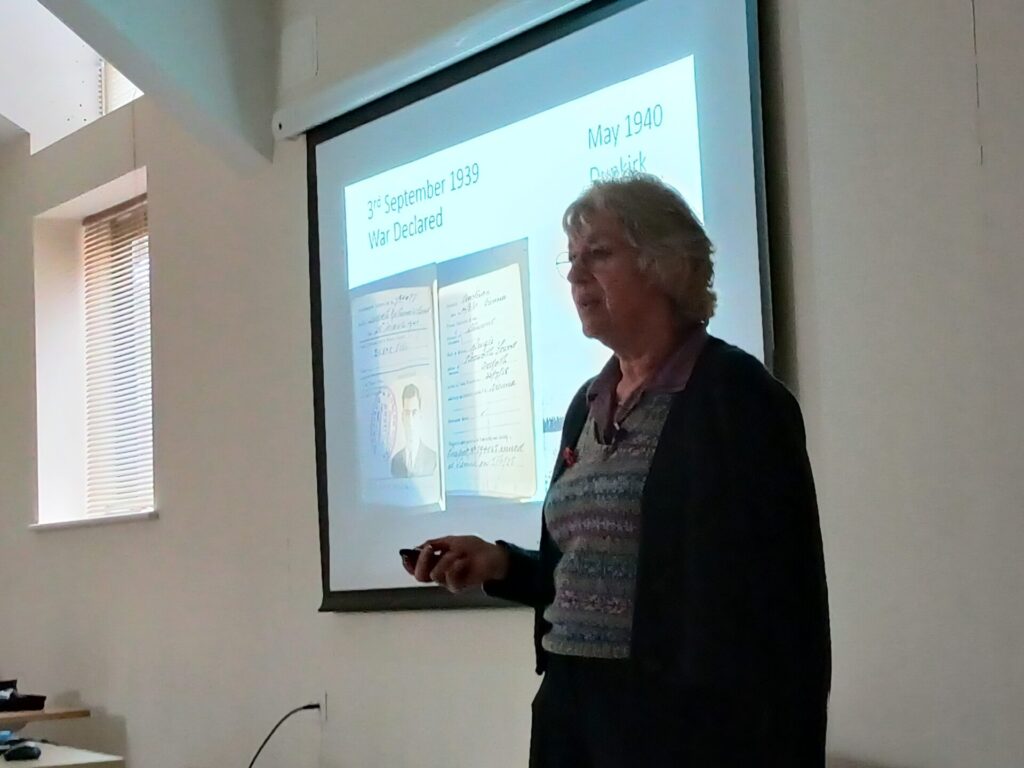
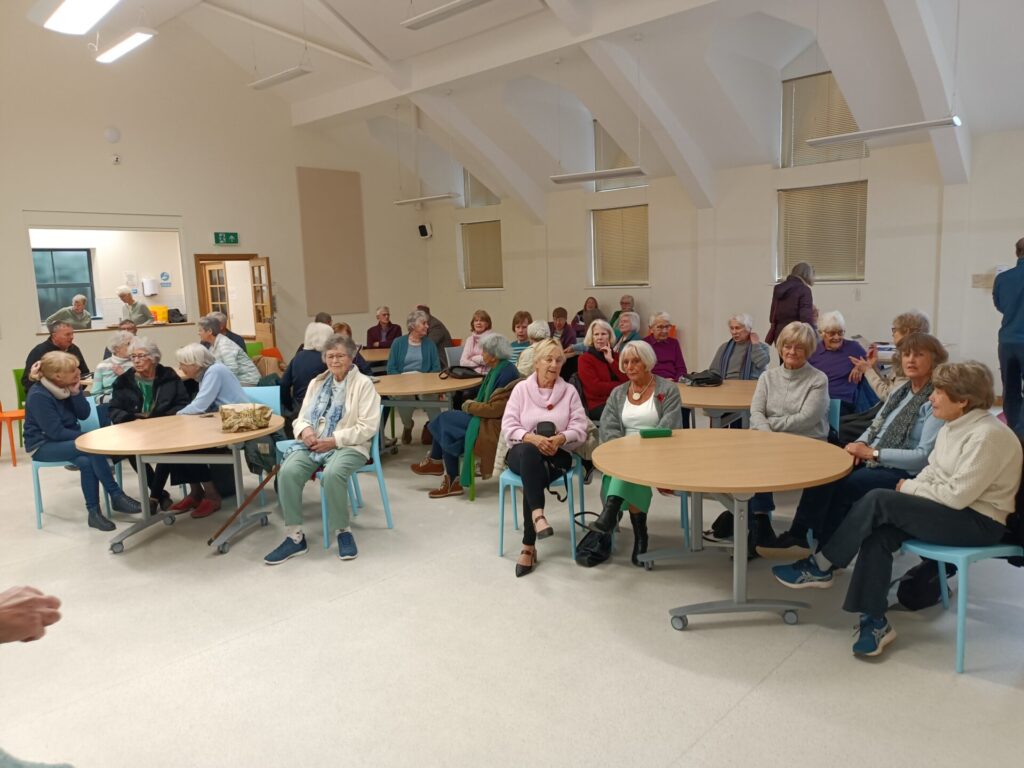
Our speaker was Vivien Seiber, author of Kino and Kinder.
Vivien spoke of the anti-Semitism that affected her family from the 19th Century right up to and including World War Two, with many illustrations and references to, for instance the November Pogrom - previously known as Kristallnacht or the Night of Broken Glass, How her family were affected and her relatives involvement with the Kindertransport refugees in the UK.
Of course illustrated with many slides, and a poignant family tree - some of her relatives were sent to Auschwitz and another of the several death camps; one to a ghetto (life expectancy was 6 to 9 months - starvation or disease claimed many lives) but others survived.
The story started in 1886, when one anti-Semetic policy came to an end, with Jewish people being allowed to buy property in Austria for the first time. This enabled Vivien's grandmother to purchase a small shop, and sell Couture - fashion. The business prospered and expanded, by 1915 there were 3 shops and then a cinema was bought too.
But anti-Semitism increased with the Nazis annexing Austria in 1938; it was subtle at first - films could not be shown if they had a Jewish cast - the film industry was badly affected. Offers to buy the cinema were made, at well below true value, and decreasing until eventually it was just commandeered and handed to a member of the Nazi party; raising money - to evacuate- became impossible - furniture was worthless as the market was flooded.
Jewish people were forced to do menial work - cleaning the pavements with acid, and using toothbrushes (and bare hands) was mentioned
Against this background the Kindertransport happened; December 1938; the children were often taken to the Stations by friends or relatives rather than their parents, to reduce the emotional impact; there was no funding for the transport,and there were conditions - a £50 (equivalent to £3500 at todays prices) bond was needed for the "return fare"; there needed to be arrangements for someone to take care of the children on arrival; Vivien referenced "One Life" the Nicholas Winton film for more information.
There were 4 "Kindertransport" trains - 3 got through; the fourth, and everyone on it, vanished.
Some of the "Kinder" girls went to a hostel on the sea front at Tynemouth - this was staffed by Paula, Vivien's mother - there was no funding and it was difficult to run - and, eventually they had to move as the area became a defense zone. A house on Windemere was found and used - actually much better. There were 25 Kinder girls there - they were divided and managed in groups by size! The "Large" ones took care of the "medium" ones, who in turn took care of the "small" ones. They went to the local School, full of local children, and evacuees from the conurbations.
Internment of all "hostile aliens" from 16 to 60 came in 1939, and Peter, one of the family was sent to Canada under this. Eventually he was able to join the Navy (the first "enemy alien" to be allowed to do so) initially on minesweeper, but then his bi-lingual German / English skills were recognised and he went into "intelligence", after the war, travelling through Europe and revisiting Vienna, the shop, the cinema, and so on. The cinema was in disrepair, the Nazi had taken the money but not invested in the building.
With the end of the war, and of course the children growing up, they got jobs such as nursing or went into further education, though there was no funding for this; some travelled to Israel. By 1989, they were all over the world - South Africa, Australia, USA all mentioned.
In total, 65,000 Austrians were murdered in the Holocaust; there is a memorial wall, and the BBC have done a podcast The Girls: The Holocaust Safe House; following that The One Show featured the story too.
Eventually the Cinema was returned to the family.
Vivien was able to put the story together as her father had amassed a case full of papers, and been in contact with the Kinder evacuees- the case was found when her Dad died in 2000- he'd produced a manuscript, but it had not been published.
A fascinating talk with much content and great depth, several intertwined stories, difficult to keep track of! I hope I have done Vivien - and her family, and their stories - justice.
Vivien's book "Kino and Kinder: A Family's Journey in the Shadow of the Holocaust" i2i Publishing is available online and for Kindle.